In this guide
Quick answer
Measure the area in metres, multiply length × width × depth to get cubic metres, then multiply by about 1.6 to get tons of sand. Example: a 5 m × 4 m area filled 0.3 m deep is 6 m³, which is about 10 tons. For filling that will be compacted, add about 15 to 20 percent. For concrete, plaster and mortar, use the job tables below, because only part of the mix is sand.
Order too little and the masons stand idle waiting for a second truck. Order too much and you pay for a pile of sand that sits in front of the villa for months. Both happen every week in Abu Dhabi, and both are avoidable with ten minutes and a tape measure.
This guide shows you how to work out how much sand you need for the jobs our customers ask about most: filling a plot, concrete, plaster, block mortar, interlock paving, gardens and play areas. Every example ends with the number of tons and the truck to order.
The Basic Formula
To work out sand, measure in metres and multiply length × width × depth to get cubic metres, then multiply by 1.6 to get tons. Add 10% for waste, or 15 to 20% for filling that will be compacted. For example, 10 m × 10 m × 0.2 m is 20 m³, about 32 tons before the allowance.
Every sand calculation starts the same way.
- Measure in metres. Length and width of the area, and the depth or thickness. 300 mm is 0.3 m, 50 mm is 0.05 m.
- Volume: length × width × depth = cubic metres (m³).
- Weight: m³ × 1.6 = tons of sand.
- Allowance: add 10 percent for waste, or 15 to 20 percent for filling that will be compacted.
Quick check
One ton of dry sand is about 0.6 m³. A 3 ton pickup is roughly a pile 2 m wide, 2 m long and half a metre high.
Sand for Filling and Raising a Plot
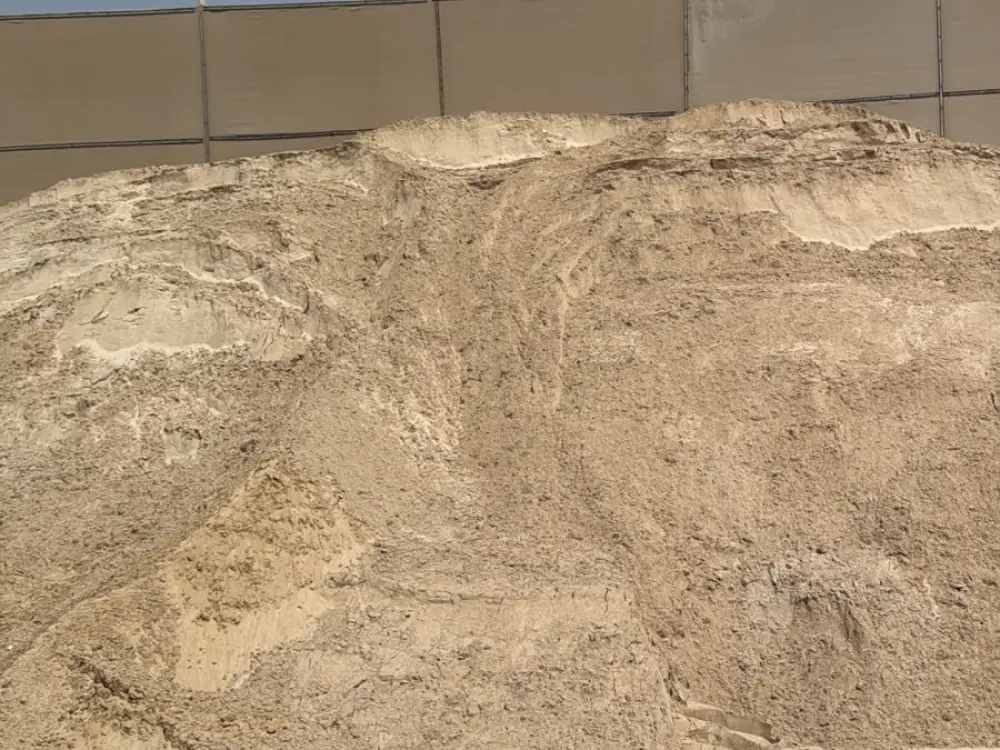
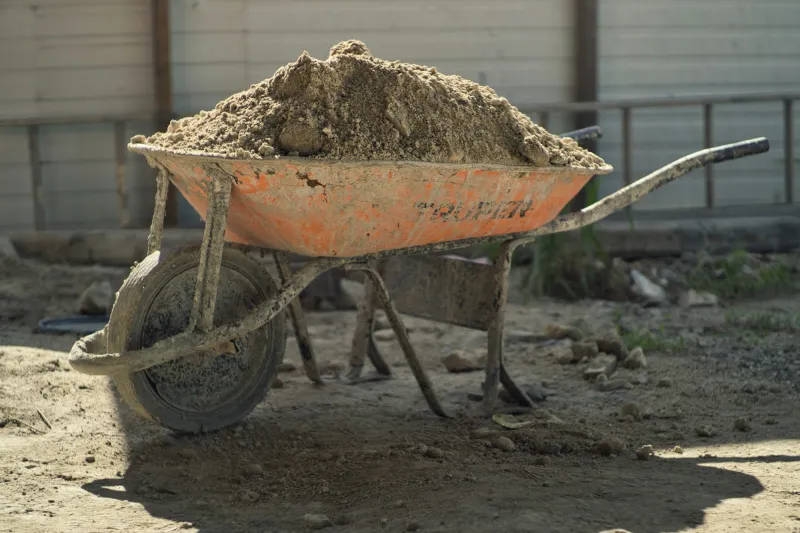
For filling and raising plot levels the whole volume is sand, usually dune sand (Dafan). Loose sand shrinks when it is compacted, so add 15 to 20 percent.
| Area | Raise by | Volume | Tons (with allowance) | Trucks |
|---|---|---|---|---|
| 10 m × 10 m yard | 200 mm | 20 m³ | About 37 tons | One trailer |
| 20 m × 30 m villa plot | 300 mm | 180 m³ | About 330 tons | About 9 trailers |
| 25 m × 40 m plot | 500 mm | 500 m³ | About 920 tons | About 24 trailers |
Where the fill will carry a slab or a yard, the top layer is often gatch material or road base instead of sand. Ask your engineer or contractor for the layer thicknesses.
Sand for Concrete
One cubic metre of 1 : 2 : 4 site concrete needs about 0.7 tons (0.45 m³) of black sand, 1.4 tons of 3/4 or 3/8 aggregate and 6 to 7 bags of 50 kg cement. A 6 m × 5 m slab, 150 mm thick, is 4.5 m³ of concrete and needs about 3.2 tons of sand and 6.3 tons of aggregate.
In concrete, sand is only part of the mix. For a common site mix of 1 cement : 2 sand : 4 aggregate, one cubic metre of finished concrete needs roughly:
- About 0.45 m³ of black sand, which is about 0.7 tons
- About 0.9 m³ of 3/4 or 3/8 aggregate, which is about 1.4 tons
- About 6 to 7 bags of cement of 50 kg
| Concrete job | Concrete volume | Black sand | Aggregate |
|---|---|---|---|
| Slab 6 m × 5 m, 150 mm thick | 4.5 m³ | About 3.2 tons | About 6.3 tons |
| Boundary wall footing 40 m × 0.6 m × 0.3 m | 7.2 m³ | About 5 tons | About 10 tons |
| Driveway 8 m × 4 m, 120 mm thick | 3.8 m³ | About 2.7 tons | About 5.4 tons |
Structural concrete must follow the mix your engineer gives. These numbers are for planning your order. Never use dune sand in concrete. Our guide on whether desert sand can be used for concrete explains why.
Sand for Plaster
With a 1 : 4 mix, 100 m² of wall takes about 2 tons of sand for 12 mm inside plaster and about 3.5 tons for 20 mm outside plaster. Measure length × height of every wall to be plastered, take off large openings and count both sides if both are plastered. Use black sand outside and white sand for a fine inside finish.
Plaster sand depends on the wall area and the thickness. With a typical 1 cement : 4 sand mix, plan on roughly:
| Wall area | 12 mm inside plaster | 20 mm outside plaster |
|---|---|---|
| 50 m² | About 1 ton | About 1.8 tons |
| 100 m² | About 2 tons | About 3.5 tons |
| 300 m² | About 6 tons | About 10.5 tons |
To get the wall area, add up length × height of every wall to be plastered and take off large openings such as doors and windows. Remember both sides of a wall if both are plastered. Use black sand for outside walls and the first coat, and white sand for a fine inside finish.
Sand for Block Mortar
A wall of standard 200 mm hollow blocks uses about 12.5 blocks per square metre. As a planning figure, allow about 1 ton of black sand for every 300 blocks laid, with a 1 cement : 5 sand mortar. A villa extension of 1,500 blocks needs about 5 tons of sand for the mortar alone, before plaster.
Order sand by the job


Sand for Interlock Paving and Artificial Grass
Paving and artificial grass use crushed materials, not soft sand, under the surface:
- Interlock pavers: about 150 mm of compacted road base, then 30 to 50 mm of interlock sand (3/16) as bedding. For 100 m² that is about 30 tons of road base and 5 to 8 tons of 3/16. If old paving has dipped, read why interlock pavers sink.
- Artificial grass: about 75 mm of road base and 25 mm of 3/16. For 60 m² that is about 9 tons and 2.5 tons. Full details are in our guide on what to put under artificial grass.
Sand for Gardens and Play Areas
- New planting beds and lawns: 150 to 300 mm of red sweet sand. A 10 m × 5 m garden at 200 mm is 10 m³, about 16 tons, one 6 wheel truck.
- Kids sand play area: 300 mm of clean white sand. A 3 m × 3 m area is 2.7 m³, about 4.5 tons, two pickups.
From Tons to Trucks
Once you have the tons, divide by the truck size. A pickup carries about 3 tons, a 6 wheel tipper about 18 to 20 tons and a trailer about 36 to 40 tons. Our guide on how many tons are in a sand truck explains which truck fits your street. If you would rather not do the maths, the sand calculator on our homepage gives the tons and trips in seconds.
Common Mistakes When Working Out Sand
The most common sand calculation mistakes are mixing millimetres and metres (50 mm is 0.05 m, not 0.5 m), forgetting the extra 15 to 20% for compacted fill, counting a whole concrete volume as sand when a 5 m³ slab needs only about 2.25 m³, and ordering every stage at once so sand sits in the sun and wind.
- Mixing millimetres and metres. 50 mm is 0.05 m, not 0.5 m. This one mistake makes an order ten times too big.
- Forgetting compaction. Filling sand settles. Without the extra 15 to 20 percent you will be short.
- Counting all the concrete as sand. A 5 m³ slab does not need 5 m³ of sand. It needs about 2.25 m³ plus aggregate.
- Ordering everything at once. On a villa job, order filling first, then concrete materials, then blocks and plaster sand as each stage starts. Sand left in the sun and wind for months gets dirty and blows away.
Ordering the Right Amount in Abu Dhabi
There is no minimum order, so you can start with one load and top up as the work goes. We deliver across the emirate, including Mussafah, Al Shamkha and Al Ain. Unsure which sand fits each job? See the types of sand for construction. We are a sand and gravel supplier in Abu Dhabi loading from Mafraq Industrial Area every day, and we would rather help you order the right amount than sell you an extra truck.